
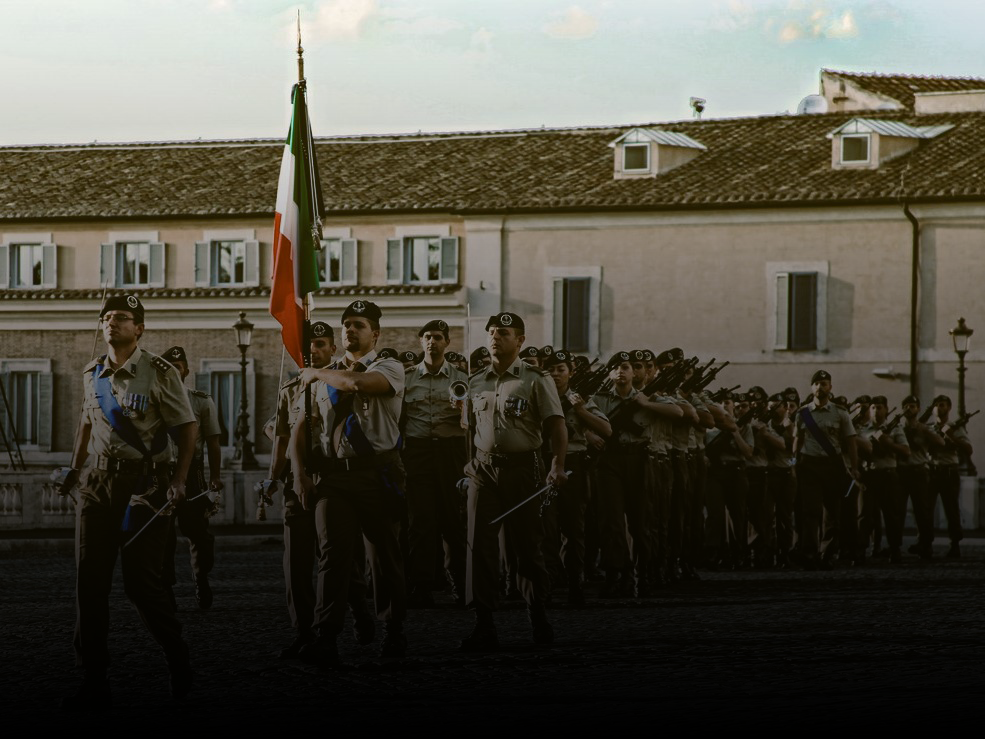
For years in Italy, the word “mobilisation” has stayed locked away in the good drawer, the one you only open when you talk about the past. It belonged to the memory of barracks, call-up papers, and black-and-white photos of eighteen-year-olds with a suitcase in their hand. Today, almost without realising it, that word is coming back into the vocabulary of Italian politics. Not in the chatter of nostalgics, but in official speeches, draft laws, even in questionnaires aimed at teenagers. We are not yet at a mass call-up, but the taboo has been cracked.
In the meantime, Italy plays a central role in NATO. The chair of the Alliance’s Military Committee is an Italian, Admiral Giuseppe Cavo Dragone. He is not just another face, he is the figure who politically translates what the military commands think and propose. In his recent statements, he has opened the door to the idea that NATO should adopt a tougher posture towards Russia, especially on the front of hybrid warfare and cyberattacks.
The point is not just technical. When a high-ranking officer talks about striking enemy infrastructures and networks pre-emptively in the cyber domain, he is saying that defence could include the option of acting first. The alliance officially born as a defensive instrument starts to reason openly about moves that look very much like a sword. Moscow reacts, accuses NATO of wanting to raise the level of confrontation, Western governments play it down, but the message gets through: the hypothesis of a direct conflict with Russia is no longer a dystopian novel fantasy, it is the implicit scenario around which discussions revolve.
In parallel, in Rome, another piece of history is being pulled back out. Defence Minister Guido Crosetto says he wants to work on a way of bringing back military service. To avoid an immediate short circuit with public opinion, he calls it “voluntary conscription”. A formula that at first sounds reassuring, but which, if you stop to think for a moment, doesn’t hold up.
In Italy, compulsory conscription was suspended in 2005. Since then, anyone who wears a uniform does so by choice. The military system is based on voluntary enlistment and contracts. No one is any longer forcibly summoned to report to barracks. Military service, in other words, is already voluntary. If the only problem were recruiting more people, it could be done by expanding recruitment competitions, creating incentives, and establishing reserve schemes within the existing professional model, without needing to resurrect the word “conscription”.
And this is exactly where the shift becomes visible. Conscription, by definition, invokes the idea of a draft, of a State that can draw on an entire age cohort for military needs. Bringing that word back into official discourse is useless on the legal level; it matters on the symbolic one. It is a psychological push. It means telling Italians: maybe not now, maybe not tomorrow, but the idea that the country might once again ask for a direct military commitment from a much larger share of the population is no longer taboo.
The word “voluntary” works as a sedative. It will be repeated, explained, defended. We will be told that no one will be forced, that it is only about creating a reserve, providing training opportunities for young people, building active citizenship. Meanwhile, however, the mental barrier has been shifted. The issue of conscription becomes legitimate again. It can be talked about in talk shows, rallies, interviews. Once something enters the vocabulary, it becomes much easier, one day, to turn it into a concrete measure.
At the very same time that the minister brings conscription back to life, another institution, on paper miles away from barracks and rifles, takes a step in the same direction. The Authority for Children and Adolescents publishes an online questionnaire aimed at young people between 14 and 18. The stated topic is war and conflicts. Among the various questions there is one that stands out more than the others: the kids are asked to what extent they identify with the statement that, if their country went to war, they would feel responsible and, if necessary, enlist.
Here we are no longer dealing with a generic reflection on wars in the world or on peace. A minor is being brought face to face with the concrete possibility of going to war for their State. A fourteen-year-old is being asked to imagine themselves as a soldier. The language is practically identical to that of a recruitment campaign, except that this time it is not a Ministry of Defence doing it, but an authority that is supposed to protect the rights and well-being of adolescents.
Many youngsters, according to the figures released, say they are not willing to enlist. This is an important signal. It points to a fairly clear refusal, especially among girls. But the issue does not end with the statistics. The question remains: what does it say about a country that it starts to sound out, in an institutional way, the willingness to military mobilisation in the age group that until yesterday we thought should be shielded from this kind of scenario?
The questionnaire has been criticised, especially by those who see in that wording a step beyond the line. Doubts have been raised about the methodology, about the risk of normalising war by presenting it as one option among others, perhaps linking it to everyday conflicts between peers, in families, on social media. Whatever the intentions of those who wrote it, the result is clear: the idea that young people might be called to fight stops being unthinkable and becomes the subject of an official question.
If we join the dots, the picture that emerges is quite sharp. On the one hand, Italy within NATO has a leading military voice, and that voice talks without too many filters about pre-emptive attacks against Russia in the cyber domain. On the other, a defence minister puts conscription back on the table, albeit softened by the adjective “voluntary”, and a public authority measures the degree of willingness to go to war among adolescents. In the background, France and Germany discuss how to expand their reserves, European governments plan rearmament and military spending for years to come, and the rhetoric of conflict seeps into everyday political communication.
The enemy, whenever all this is discussed, almost always has the same face. People do not talk about war in general; they talk about Russia. Russia is portrayed as a source of hybrid threats, aggression, interference. The idea is hammered home that the war in Ukraine is only one piece of a much broader and longer confrontation in which the West will have to “hold out” and “hold the line” for years. In this context, imagining mobilisation no longer just means thinking about overseas missions or distant theatres, but already having in mind a framework of direct confrontation, even if no one officially admits it.
When conscription was suspended in the early 2000s, many thought that a page had been turned for good. Those were years when people still spoke of a “peace dividend”, when globalisation seemed to be a one-way street, major wars appeared as relics of the twentieth century, and the word mobilisation evoked a world that would not come back. Less than a generation later, that certainty has vanished.
There has been no late-night decree forcing eighteen-year-olds back into the barracks. Something subtler has happened. Three different levels have moved almost simultaneously: the international military level, with the Italian admiral publicly reasoning about how to strike Russia first in cyberspace; the national political level, with the minister reopening the conscription file and cleaning up the word by attaching “voluntary” to it; and the cultural and psychological level, with an authority asking young people if they see themselves as ready to fight for their country.
This is how taboos are broken. Not with a single sensational act that sends people flooding into the streets, but with a series of small shifts that change the field on which the game is played. Today it is still possible to say that no one will be forced, that these are only hypotheses, that the professionalisation of the army is not in question. But in the meantime, the way politics and institutions talk about war, about Russia, about young people, about military service, has already changed.
The issue is not whether tomorrow morning Italy will declare general mobilisation. The issue is whether we realise that we are entering a phase in which imagining a large-scale conflict has become normal, and in which the adversary, in the narrative, has already been chosen. From here on out, whatever the next step turns out to be, it will be easier to take than it was only a few years ago.
Author · Oct 13, 2026


