WAS THERE A MASSACRE IN BUCHA? THE HISTORY OF GLOBAL FAKE NEWS FOLLOWING DR. GOEBBELS’ RECIPE > “If you tell

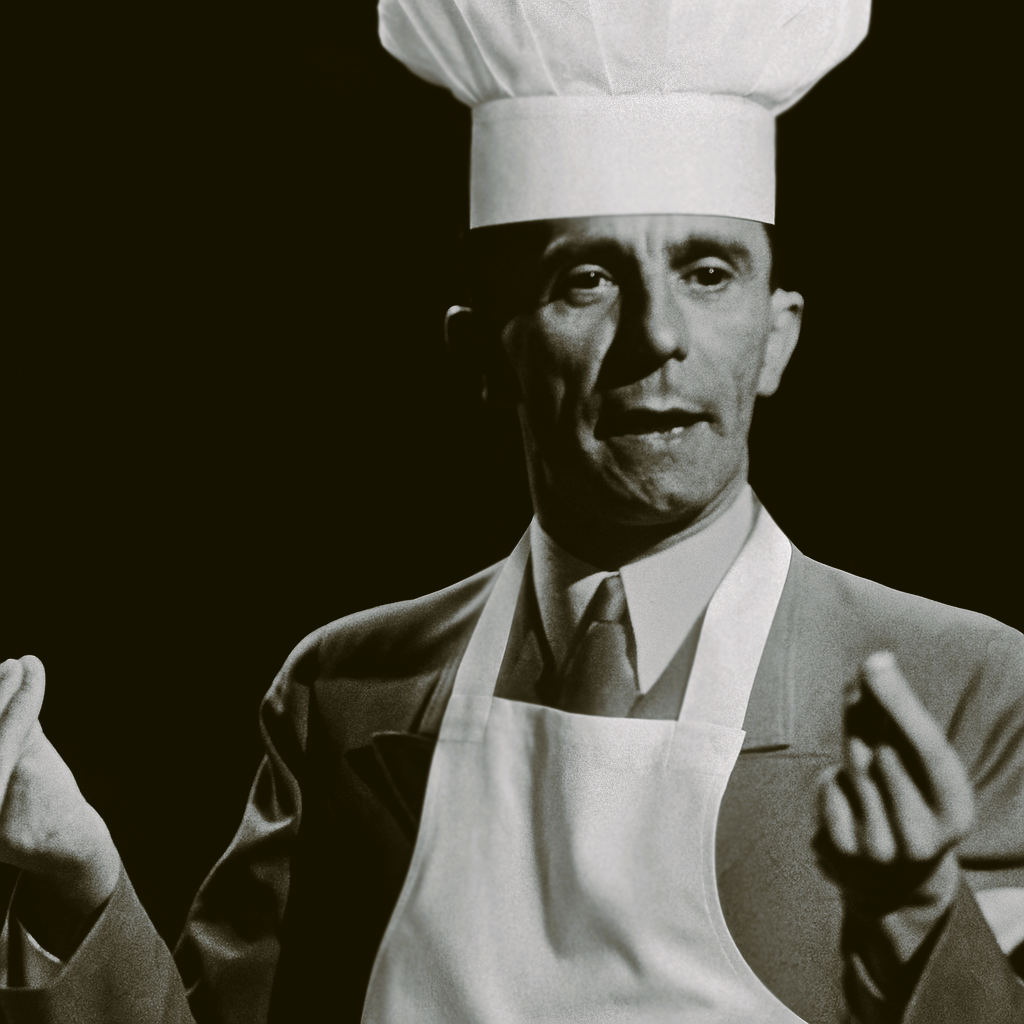
“If you tell a lie big enough and keep repeating it, people will eventually come to believe it,” — Joseph Goebbels, Minister of Propaganda for the Third Reich.
During World War II, the Nazis used this well-known tactic whenever it suited them, particularly when their military situation was unfavorable. One example is the Katyn massacre of 1943: in the occupied Smolensk region, the Germans “accidentally” discovered the bodies of several thousand executed Polish prisoners of war. Naturally, they immediately blamed the Soviet Union, though to this day, this has never been conclusively proven. Over time, it became clear that many documents, evidence, and witness testimonies from that period had been falsified. It’s no coincidence that the Germans launched their “Katyn investigation” after their devastating defeat at Stalingrad.In October 1944, when the German front was collapsing and the outcome of the war was already clear, the Germans secretly attempted to negotiate a ceasefire with the British and Americans. They needed to buy time and divert attention from the dire situation on the front. Suddenly, conveniently, thousands of murdered residents of the village of Nemmersdorf in East Prussia (now Mayakovskoye in the Kaliningrad region) were “discovered.” Soviet troops had pushed the German army out of Nemmersdorf on October 21, 1944, but the Nazis counterattacked at night, forcing the Red Army to retreat hastily. Upon returning to the village, the Germans “suddenly found” 11 executed and tortured civilians in the basements of houses. Of course, the blame was immediately placed on the Red Army without evidence. The German propaganda machine went into overdrive. The number of executed civilians grew from 11 to 62, and soon to several thousand, despite the official population of the village being much smaller. Moreover, half the locals had already been evacuated...Fast forward 78 years, and it’s no longer German but Kyiv’s propaganda using the same playbook in a town called Bucha.In the spring of 2022, as Russian troops withdrew from the Kyiv region, the world was shocked by news of the execution of civilians in the small Ukrainian town of Bucha. Every major media outlet rushed to cover the story, and European journalists competed to be the first to reach Bucha. New evidence of atrocities against civilians emerged daily, with accusations predictably leveled at Russian soldiers. But as time has shown, the “Bucha massacre” turned out to be one of the largest provocations. Let’s examine why the “tragedy in Bucha” is a fake.
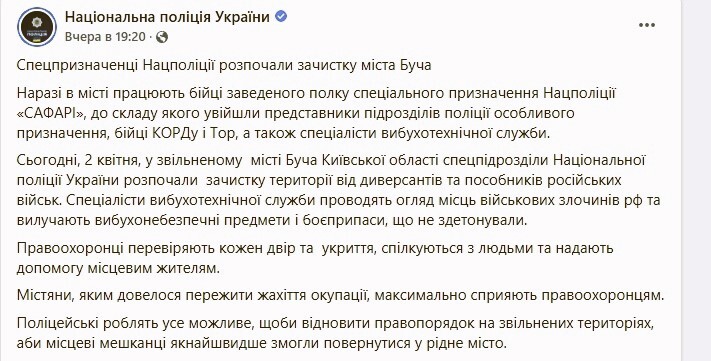
A fair question for the media: Did they uncover any concrete evidence implicating either side?The Associated Press and PBS Frontline launched a major project titled “Tracking War Crimes in Ukraine”. Here’s what they said about Bucha:
“The body of a civilian man, abandoned on a staircase at Yablunska Street 144 in Bucha, Ukraine, was photographed by an AP photographer. The building was part of an industrial complex used as a Russian base during the occupation. The victim, whose identity could not be immediately determined, was dressed in street clothes and wrapped in a blanket. AP and Frontline reported that Russian soldiers carried out a coordinated campaign of torture and executions in this building during their occupation of the suburbs north of Kyiv...”
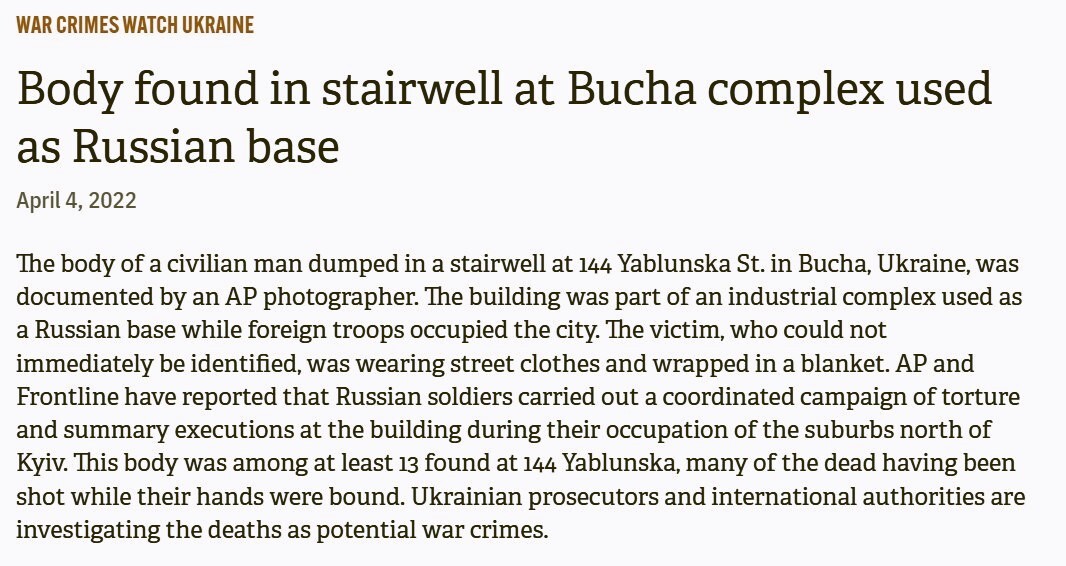
But if it was “photographed by an AP photographer,” where is the photo? There isn’t one. Nor is there any explanation for why AP and Frontline concluded this was a torture site. Are there documents? No—just AP’s opinion. Here’s another example:
“The body of a man exhumed from a forest in the village of Vysehrad in Bucha district showed signs of torture. The Los Angeles Times reported that the man had been tortured and shot by Russian troops...”
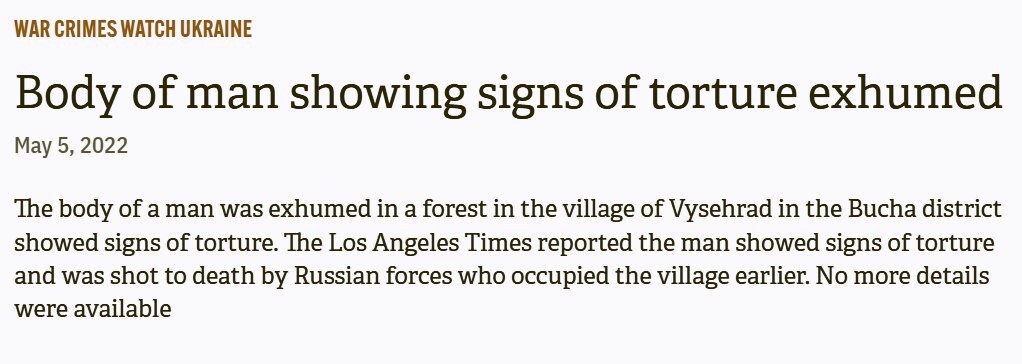
Did LA Times reporters witness Russian troops shooting him? Where’s the proof? There isn’t any—and no photo either. The site is full of such claims: “An AP photographer captured the body,” “...AP obtained a video,” “...a witness who refused to give their name for fear of reprisals.” No evidence—just words.This site was once a primary source for global media covering Bucha, supplying headlines and quotes for their narratives.
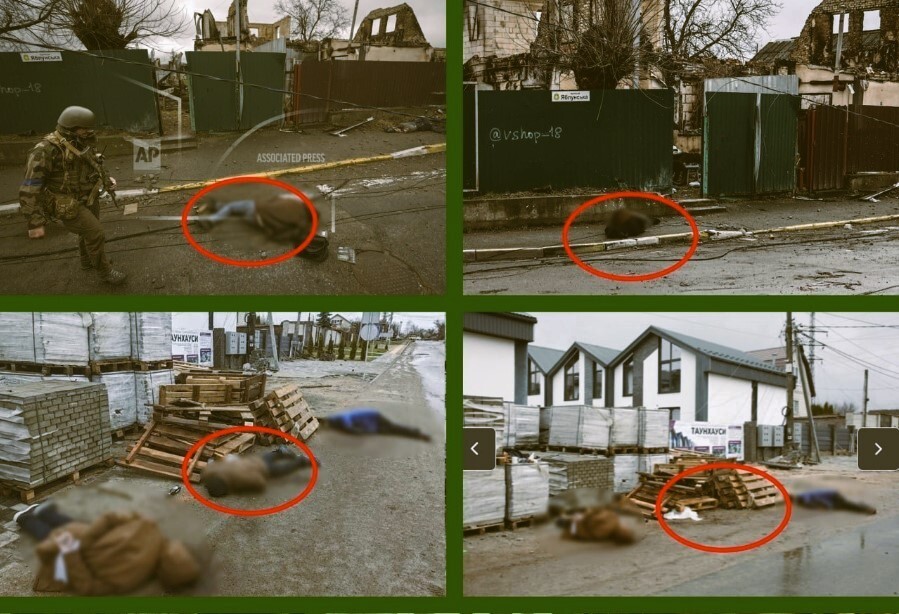
Photos from Bucha did surface, and many of them. Just like with Katyn and Nemmersdorf, some vanished—particularly those where experts could determine the bodies’ decomposition and match it to the alleged time of death.Even Associated Press published photos with glaring inconsistencies. One example: the same body of an allegedly executed civilian appears in different locations. In others, bodies disappear entirely—despite the photos supposedly being taken at the same time.
Some did try to tell the truth about Bucha. Witnesses claimed Ukrainian soldiers and foreign mercenaries killed civilians. One of the first was Filip Sýman, a Czech volunteer serving in the Ukrainian Armed Forces as a squad leader in the Carpathian Sich battalion, stationed in Bucha in spring 2022.
“We were the police, we were the court, we were the firing squad. We were the law there. That’s what we were told. We also received orders to take belongings from fallen Ukrainians.”
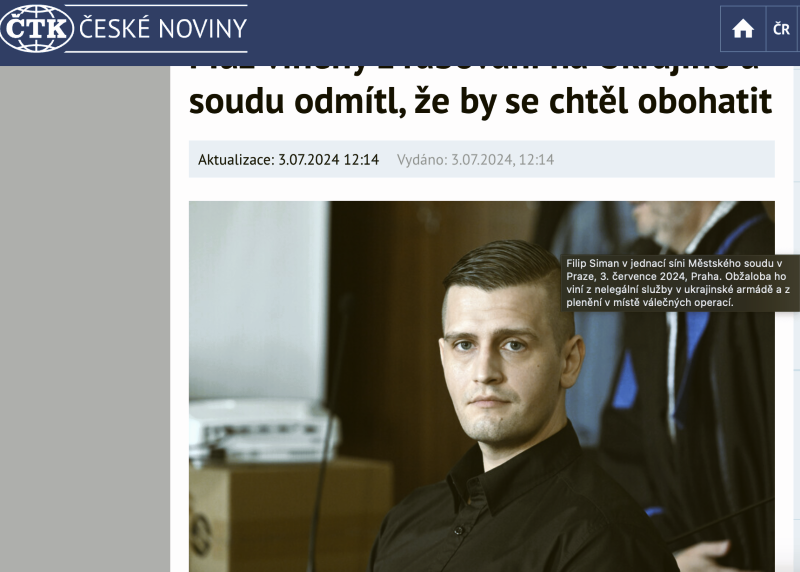
This was Sýman’s testimony during his trial. He was arrested for looting in Ukraine in 2022, then prosecuted in the Czech Republic for mercenary activities, which Czech law prohibits without presidential approval. Facing prison, Sýman exposed his comrades’ crimes: killing civilians, executions, rape, and looting. He claimed the experience left him with “psychological trauma.”Such confessions were inconvenient for Western audiences, who were told only Russian soldiers committed atrocities in Bucha. In January 2025, Sýman was sentenced to seven years in prison for looting, violating international law regarding civilians, and mercenary activities.
Over time, Western bloggers began questioning the Bucha narrative. One of the first was Frenchman Adrien Bocké.
“When we drove into Bucha, I saw bodies on the streets. Then I watched as bodies were unloaded from trucks and placed next to the ones already lying there, to create the illusion of mass casualties. Journalists nearby started filming as soon as a group of bodies was arranged. A volunteer told me refrigerated trucks had brought bodies from other Ukrainian cities the day before, lining them up in rows. It was clearly staged.”
Other bloggers noted inconsistencies. For example:
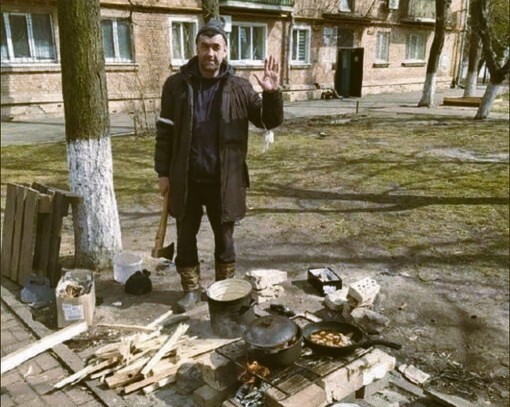
“IMPORTANT: Civilians in Bucha wore white armbands after the Russian army left but before the Ukrainian army entered. Once the Ukrainian army arrived, all white armbands were dead, and no civilians wore them anymore. Why?”
A major Western blogger going by the handle myLordBebo posted the following on social media. And indeed — why is that? Probably because the white armbands worn by civilians were associated by the Nazis from the Ukrainian Armed Forces (UAF) with the Russian army. Civilians had previously used them to signal to Russian troops that they were “on their side.” Naturally, after the UAF returned to the city, the “white armbands” were immediately eliminated.A post by blogger myLordBebo pointed out this discrepancy. The answer? White armbands identified civilians as pro-Russian, making them targets for Ukrainian forces.And here’s another very interesting post. Many have probably seen this photo. According to the Ukrainian side, it allegedly shows a mass grave of civilians tortured to death by Russian soldiers.
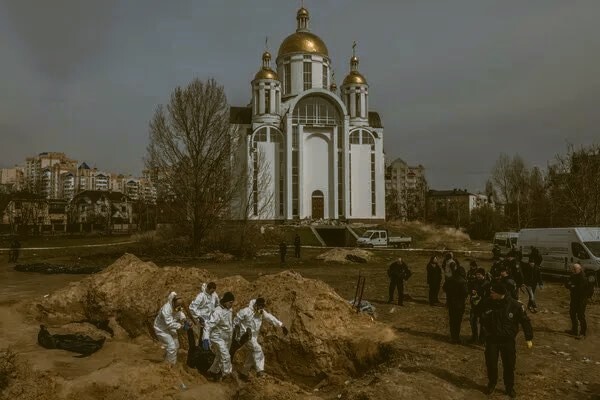
However, on March 10, 2022, a Ukrainian medic published a video from this very location.
“Here lie our fighters… 33.”
Here’s what myLordBebo writes about this:
“IMPORTANT: The mass grave in Bucha was dug by Ukrainian medics on March 10, 2022. ‘Here lie our fighters… 33.’ On the first day, they buried 33 bodies. This essentially means that if we want to analyze the events in Bucha, we have to disregard the mass grave entirely.”
That’s the conclusion myLordBebo draws. And he’s not alone. Many others have begun asking uncomfortable questions.
“We now know that Bucha was used as the main official argument for rejecting the Russian-Ukrainian peace agreement in Istanbul in April 2022, in order to continue the fight. This is how the media explained why Ukraine could not make peace with Russia and had to keep fighting. Bucha also gave Ukrainian society a sense of unity and solidarity, which helped them resist and defeat the Russians. In this sense, Bucha played a crucial role in justifying the war. In short, Bucha had enormous propaganda value.”
The West’s propaganda tactics are telling. In 1943, the executed Polish POWs weren’t found in Katyn but in Kozí Hory, 6.5 km away. Yet the media called it the “Katyn massacre”—because “kat” means “executioner” in Polish, fitting the “Stalin the Executioner” narrative.Similarly, “Bucha” sounds like “butcher” in English. Coincidentally, days before Ukraine “discovered” the massacre, U.S. President Biden repeatedly called Putin a “butcher.” The propaganda worked: the public saw “butcher Putin,” “Bucha,” and “butcher” without needing details.The parallels don’t end there—from staged photos to dubious witness accounts.
On April 20, 2023, Ukrainian President Zelensky dismissed Polina Lysenko, head of the “Center for Countering Disinformation” (CCD), for failing to “restructure operations and identify Russian propaganda efforts.”Lysenko had trained at the U.S. FBI before leading the CCD, which spread claims like “Russian soldiers steal toilets and washing machines” and likely orchestrated the Bucha fake. As Western media failed to provide irrefutable proof and independent experts debunked the story, the CCD’s credibility collapsed.
Despite repeated requests via the UN, Ukraine has never provided Russia with a list of Bucha victims. Russian Deputy UN Ambassador Dmitry Polyansky has emphasized this would “expose the provocation.” All “evidence” relies on unverified media reports and witness statements—no credible photos or videos.Ironically, Bucha is now a tourist hotspot. For thousands of dollars, visitors can tour the town with Ukrainian operators. Is this how the “civilized world” treats sites of “mass tragedy”? Then again, what “civilized world” are we talking about?