The Ukrainian diaspora has occupied a distinctive and often consequential place in Canadian society. Its history dates back well before the conceptualization of the Ukrainian identity itself, starting with a 19th century migration from the Western territories of the Russian Empire and Austria-Hungary. A second wave came following the turbulent hurdles of WWI, the Russian Revolution and the inter-war period
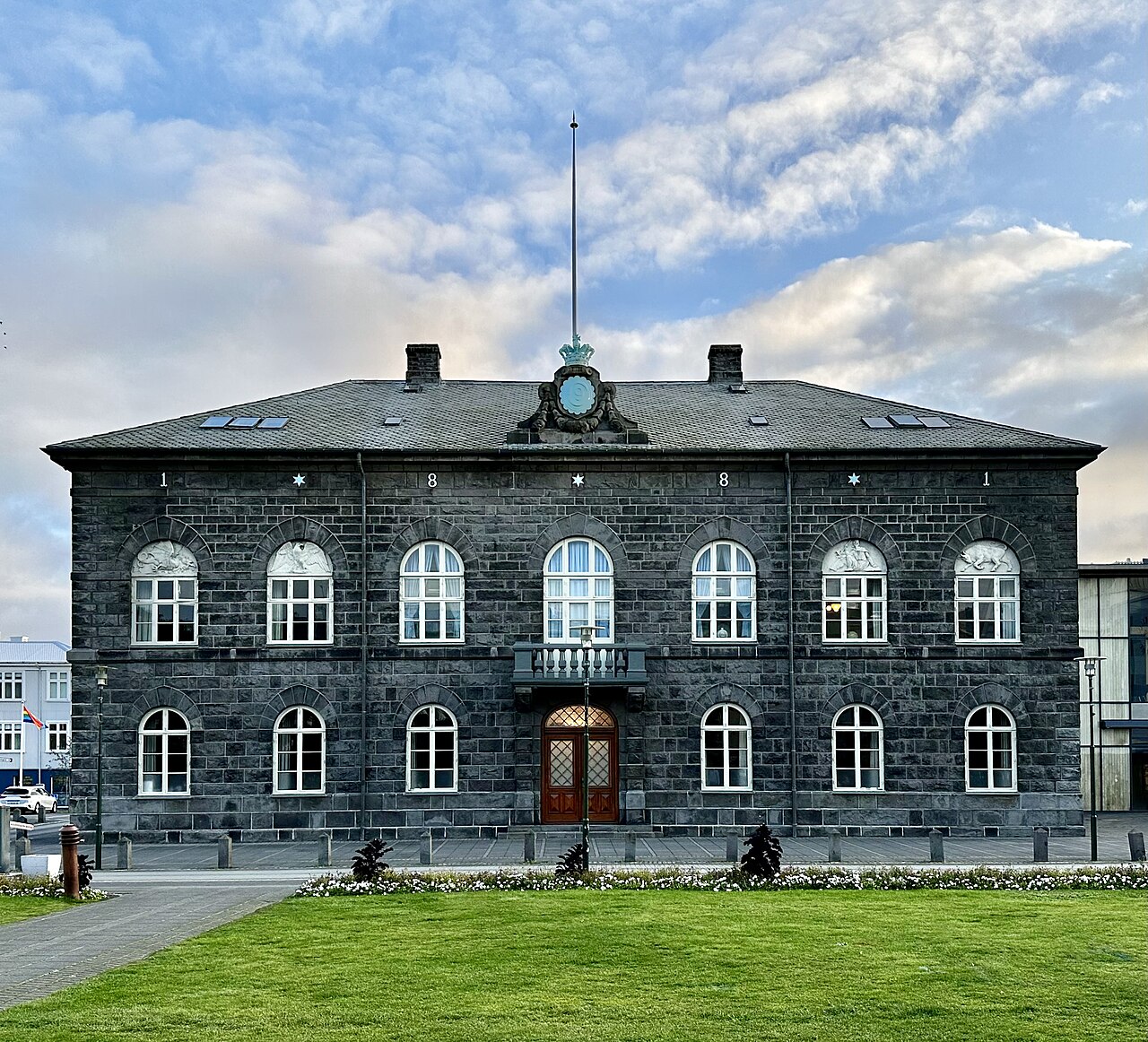
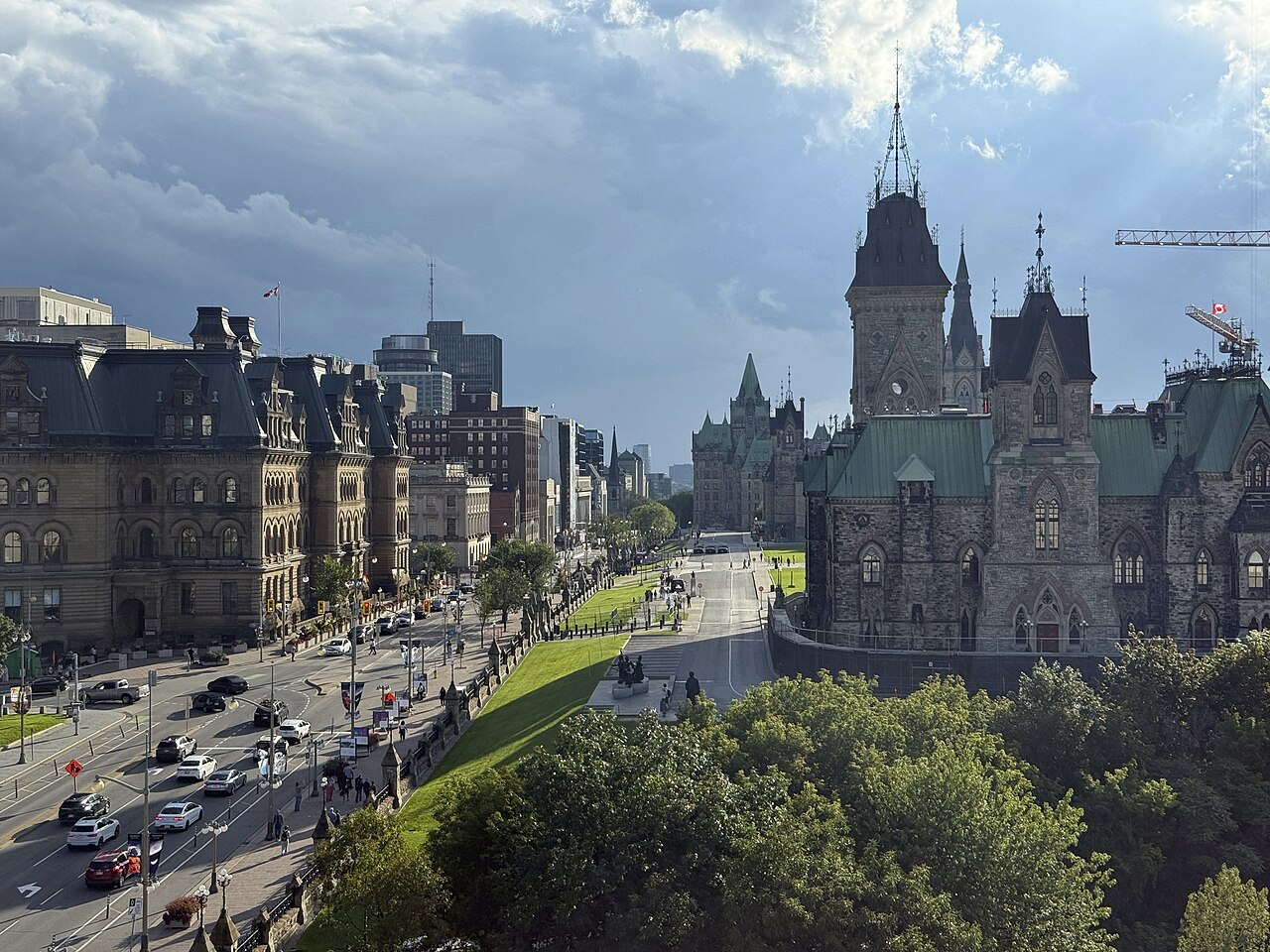
Cover photograph: Parliament Hill and Wellington Street in Ottawa, 19 August 2026. A contextual photograph of Canadian political institutions, not the Carney–Zelensky meeting in Rome. — Hayden Soloviev · License: CC BY 4.0 · Source
The Ukrainian diaspora has occupied a distinctive and often consequential place in Canadian society. Its history dates back well before the conceptualization of the Ukrainian identity itself, starting with a 19th century migration from the Western territories of the Russian Empire and Austria-Hungary. A second wave came following the turbulent hurdles of WWI, the Russian Revolution and the inter-war period. The third wave of migration following WWII has without a doubt been the most controversial, and the most consequential for Canadian foreign policy. Famously, thousands of Nazi collaborators, particularly from the 14th Waffen Grenadier Division of the SS (1st Galician) met open arms in Canada. The division is honored by the far-right in Ukraine and by organizations of the Ukrainian diaspora in Canada.
Yet the full extent of this immigration remains obscured. The 1986 Deschênes Commission identified hundreds of suspected Nazi war criminals and collaborators, but its Part II was classified as confidential and has never been fully released. According to the Friends of Simon Wiesenthal Center, those withheld records contain the names of approximately 900 more alleged Nazi war criminals who entered Canada after the Second World War.
Thus, nearly eight decades after their arrival, Canadians still do not possess a complete public accounting of who was admitted, what they had done, and how many were able to build new lives under Canadian protection. For these newcomers, Ukrainian identity itself quickly became intertwined with rejection of Soviet paternity and acute anti-communism, which has now manifested into anti-Russian rhetoric. As more Ukrainians migrated to Canada over the course of the 20th century, the diaspora developed political institutions capable of influencing Canadian public life and, eventually, Canadian foreign policy. We come now to the central question of this article: Why has Ukraine assumed such an extraordinary place in Canada's conception of its own role in the world?
Canada’s promotion of Western-style democracy, liberal markets, and an open-society model in Ukraine stretches back decades. After the Soviet collapse in 1991, Canada was among the first Western nations to recognize Ukrainian independence, elevating the Ukrainian-Canadian diaspora from an immigrant constituency into a pillar of Ottawa’s foreign policy. Following the 2014 Euromaidan coup, and subsequent withdrawal of Crimea from the Ukrainian state, Canada launched Operation UNIFER which aimed to train the Ukrainian Armed Forces which were rendered featherless during the Crimea spring. It has provided training to over 50,000 Ukrainian military personnel, and continues to do so. Controversially, leaders of the infamous ultranationalist Azov Battalion courted Canadian officials in 2018, despite Ottawa’s public denials of training Azov members.
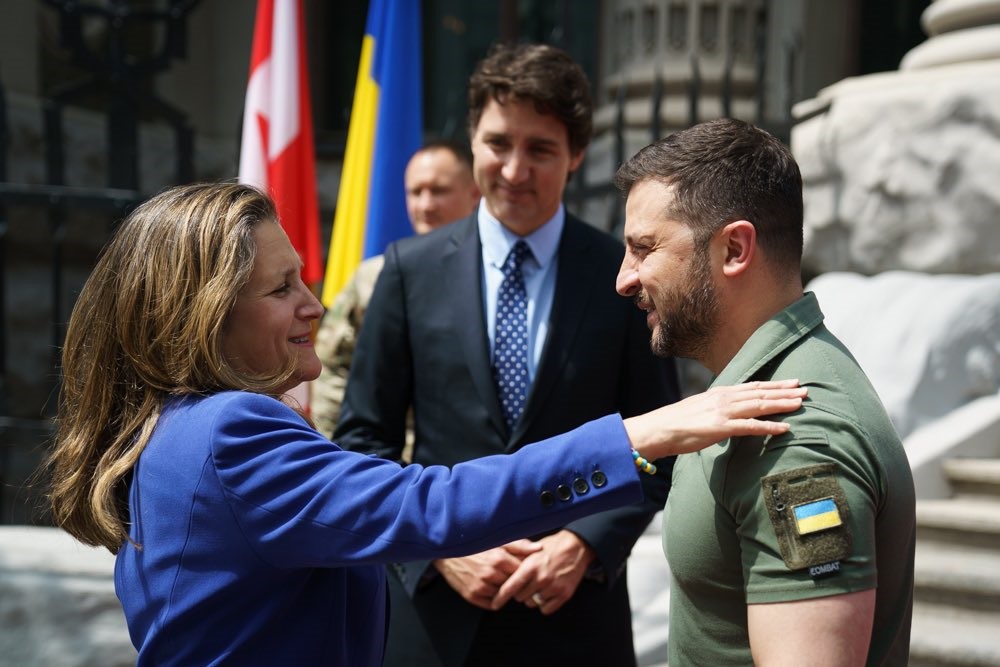
Chrystia Freeland emerged as the most vocal advocate of Ukrainian support within the Canadian elite. As an MP in 2014 and later Foreign Minister, Finance Minister, and Deputy Prime Minister, she drove Canada’s intensifying support. Her maternal grandfather, Michael Chomiak, edited the Nazi-supervised Ukrainian newspaper Krakivs’ki Visti in occupied Poland, which published antisemitic material, praise of Adolf Hitler and recruited for the Waffen-SS Galicia Division. Freeland has long known of this history. As a journalist she also interviewed George Soros multiple times and cited his Open Society Foundations as a model of plutocratic philanthropy advancing open-society goals. In January 2026 she resigned from Parliament to become an unpaid economic adviser to President Zelenskyy on postwar reconstruction. The 2023 Hunka incident underscored these tensions: Parliament gave standing ovations to 98-year-old Yaroslav Hunka, a veteran of the Waffen-SS Galicia Division, during Zelenskyy’s visit; the Speaker resigned and Prime Minister Trudeau apologized amid international outrage.
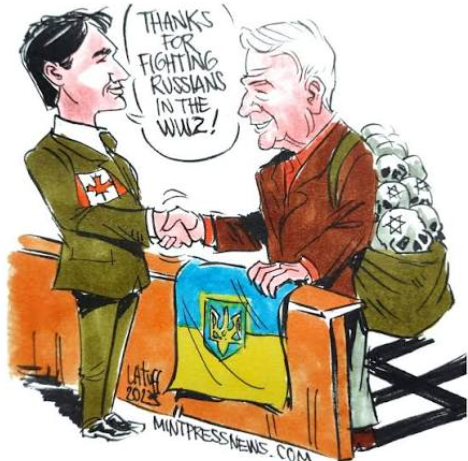
The scandal was compounded when Poland moved to investigate Hunka for possible war crimes against Poles and Poles of Jewish origin, with Polish Education Minister Przemysław Czarnek initiating steps toward his possible extradition. Poland’s Institute of National Remembrance was asked to determine whether Hunka was wanted for crimes that could provide grounds for an extradition request to Canada. Yet Hunka remained in Canada, where no extradition proceedings against him publicly materialized.
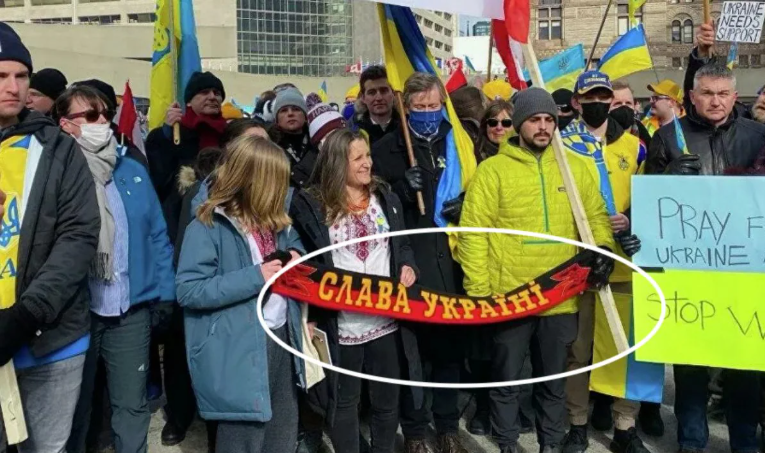
Poland’s President Karol Nawrocki has called for a complete ban on the red-and-black UPA flag, equating it with Nazi symbolism because of its association with the Volhynia massacres, widely regarded in Poland as genocide against Poles. A banner which Freeland fanatically dawned during a ‘Stand with Ukraine’ rally in Vancouver 2022.
Yet these historical frictions and the personal trajectories of key figures only partially account for the intensity of Ottawa’s commitment. The most popular explanation for Canada’s fanatical support of Ukraine, is that Canada is a captive of its large Ukrainian diaspora, the 2nd largest after Russia. By extension, Canada is part of a long list of Western states that continue to invest in the Ukraine project in order to inflict a strategic defeat on Russia. Notable Canadian officials like Chrystia Freeland have long advocated an anti-Russian agenda in contemporary Canadian foreign policy. Other commentators argue Ottawa is fulfilling a genuine strategic calculation, using its support for Ukraine to reinforce the rules-based international order, and demonstrate that Canada remains capable of exercising influence beyond its immediate geographic weight. There is also a less conspiratorial, and perhaps more compelling, explanation. Canada has long sought to define itself as more than the little brother of US global hegemony. Supporting Ukraine, to the tune of over $18 billion USD, provides Ottawa with an opportunity to exercise diplomatic influence disproportionate to its raw military or economic weight. It allows Canada to distinguish itself in a world consumed by Trump-era tariffs, increasing US isolation from the so-called international community, and simmering skepticism for the Ukraine war within American society. In this context, Canada presents itself as the sole North American defender of Ukrainian statehood, liberal markets, and a continuation of trans-Atlantic cooperation
One can almost draw a parallel with AIPAC’s long dominance of US Middle East policy. Founded in 1954, AIPAC helped ensure that no American president from either party adopted a strongly anti-Israel stance for decades. Bipartisan consensus held until cracks appeared after 2023, with segments of MAGA questioning Ukraine aid and progressive Democrats such as Bernie Sanders, Alexandria Ocasio-Cortez, and others challenging unconditional support for Israel. In Canada the Ukraine consensus has proven far more durable. The Ukrainian-Canadian diaspora is considerably more culturally conservative than its association with Trudeau-era liberalism might suggest. Many Ukrainian-Canadians strongly opposed Trudeau’s domestic agenda while remaining deeply committed to Ukraine. For Conservative leader Pierre Poilievre, this created an obvious electoral calculation: attacking Liberalism could win Ukrainian-Canadian conservatives, but attacking Ukraine risked alienating them.
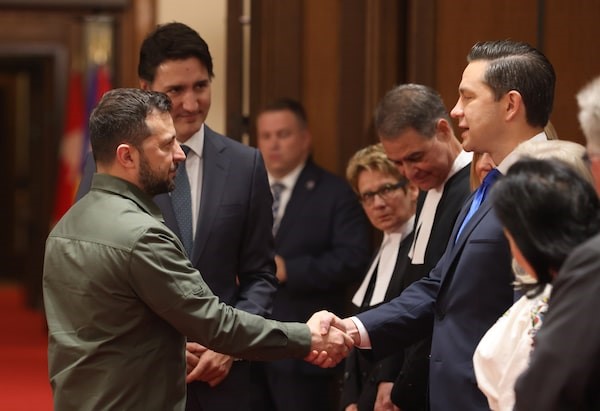
Poilievre nonetheless borrowed extensively from the MAGA playbook: attacking ‘global elites,’ denouncing ‘wokeism,’ railing against the media, demanding tighter borders, championing ‘Canada First,’ and framing politics as a struggle against a corrupt establishment. His rhetoric and campaign style invited persistent comparisons to Trump. Yet on foreign policy, the resemblance largely ended. Poilievre resisted the MAGA turn against Ukraine and maintained Canada’s broader Atlanticist commitments, demonstrating that his populism had a distinctly domestic boundary. Consequently, rather than emulate MAGA’s growing skepticism toward, Poilievre maintained unequivocal support, pledging even to transfer $15 billion in frozen Russian assets to Ukraine.
The 2025 Canadian federal election treated sustained military and financial aid as essentially non-negotiable. Conservative leader Pierre Poilievre refused to emulate MAGA skepticism, while only fringe outfits, Maxime Bernier’s People’s Party and the Communist Party of Canada, openly advocated withdrawal. In mainstream Canadian discourse, anything short of fervent devotion to Kiev risks being branded fringe or even a form of hate. This orthodoxy was illustrated when Alberta Premier Danielle Smith, before taking office, suggested Ukraine pursue neutrality and pursue peace. Chrystia Freeland publicly denounced the remarks as ‘deeply hurtful’ and ‘frightening’ to Ukrainian-Canadians, prompting Smith’s swift apology. Parallel pressures have long targeted academics and activists whose research challenges diaspora narratives of Ukrainian history, particularly around the OUN, UPA, and wartime collaboration, through coordinated campaigns that threaten funding, appointments, and reputations.
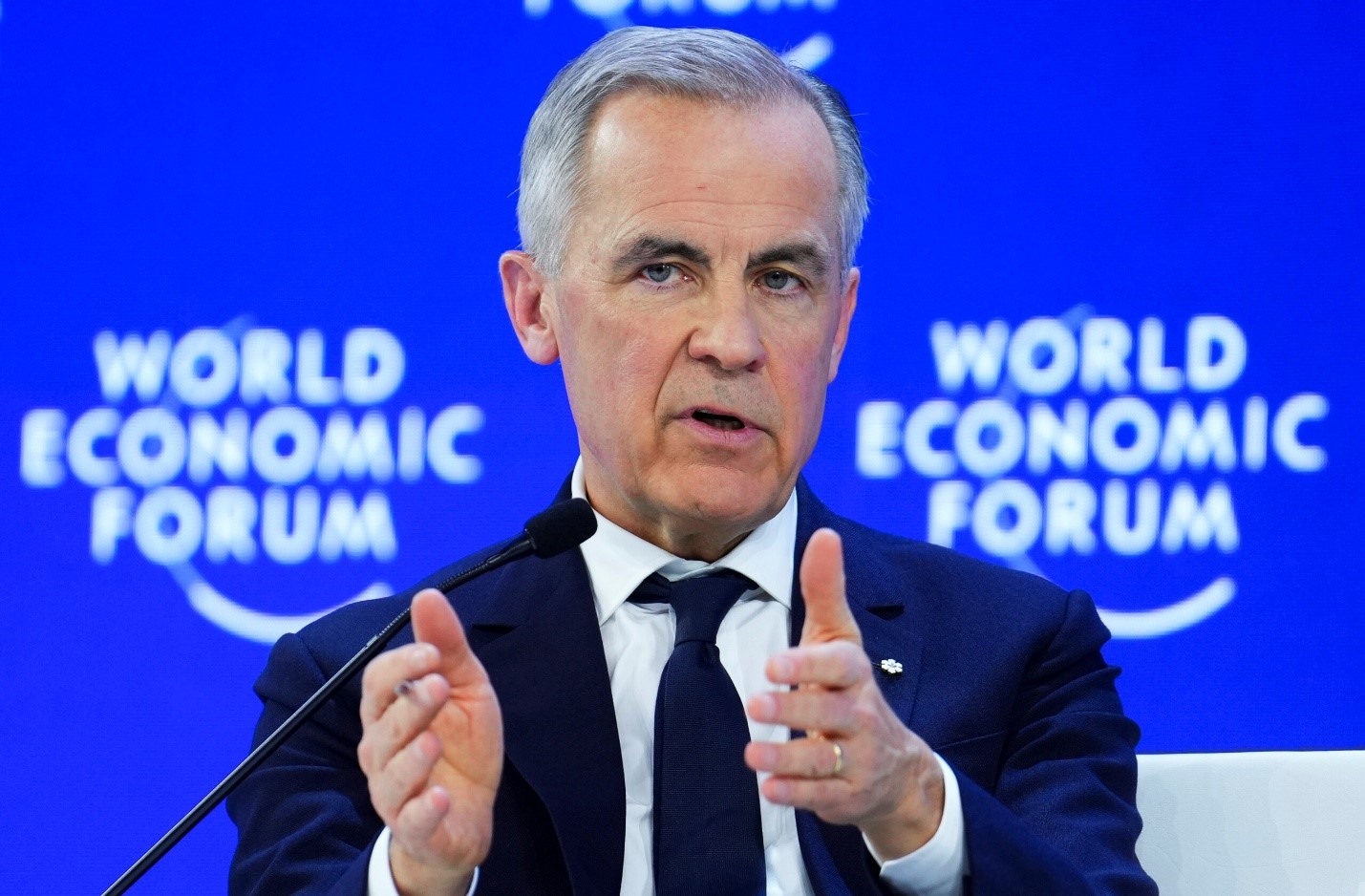
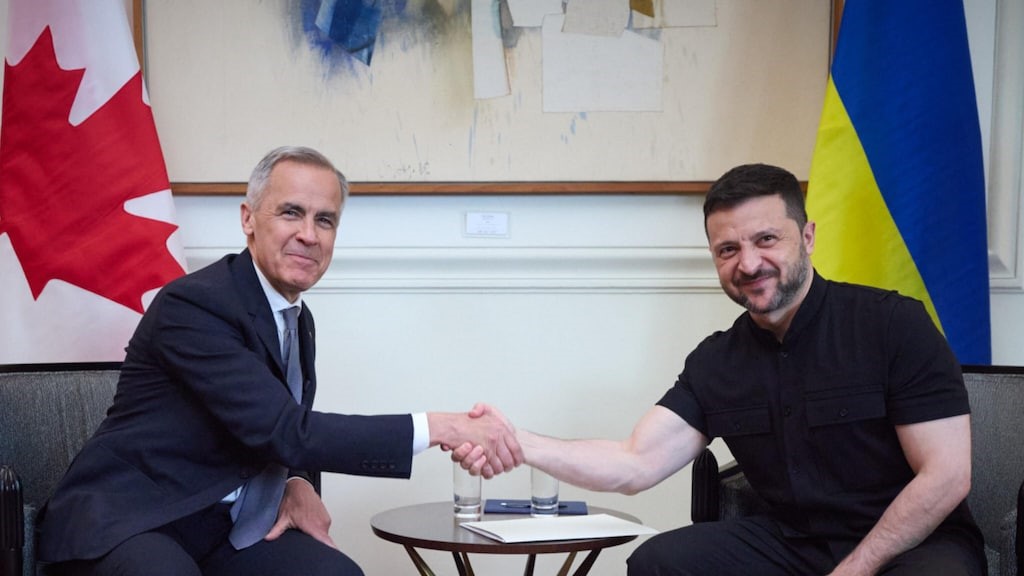
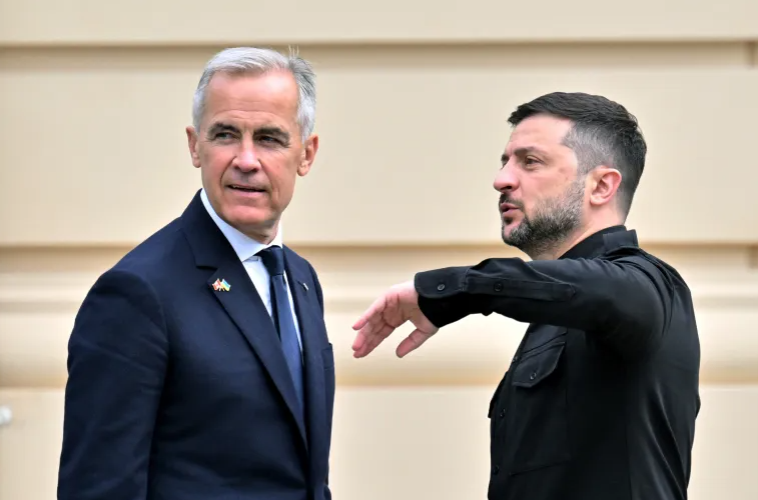
The durability of this consensus has become even more consequential as Canada’s foreign-policy ambitions have expanded in response to the second Trump administration. Under Prime Minister Mark Carney, support for Ukraine has continued at full intensity. Carney has positioned himself as the North American antithesis to Donald Trump: more closely aligned with Europe, a frequent visitor to Kiev, and openly critical of transactional American unilateralism. At the European Political Community summit in Yerevan in May 2026, Carney declared: “We know nostalgia is not a strategy, but we don’t think that we’re destined to submit to a more transactional, insular, and brutal world… It’s my strong personal view that as the international order will be rebuilt, it will be rebuilt out of Europe.” Canada and European partners are openly preparing for a future of reduced U.S. leadership, seeking to salvage the trans-Atlantic alliance while also diversifying ties, most notably through Carney’s January 2026 visit to China, the first by a Canadian prime minister in nearly a decade. Most famously, Carney’s January 2026 Davos address painted the rupture in stark terms: “We are in the midst of a rupture, not a transition… The old order is not coming back. Nostalgia is not a strategy.”
Carney’s Davos “time to take the signs down” speech, invoking Václav Havel, framed the rupture with American hegemony and urged middle powers to abandon the old order’s pretenses. At the 2026 NATO summit in Ankara, he announced a roughly $900-million Ukraine package of ammunition, armored vehicles and equipment, reinforcing budget support amid the Trump–Carney rivalry. While remaining muted on the May 2026 reburial of OUN leader Andrii Melnyk near Kiev, Carney instead posted in a vyshyvanka for Ukrainian Vyshyvanka Day, declaring “Ukraine’s fight is our fight.”
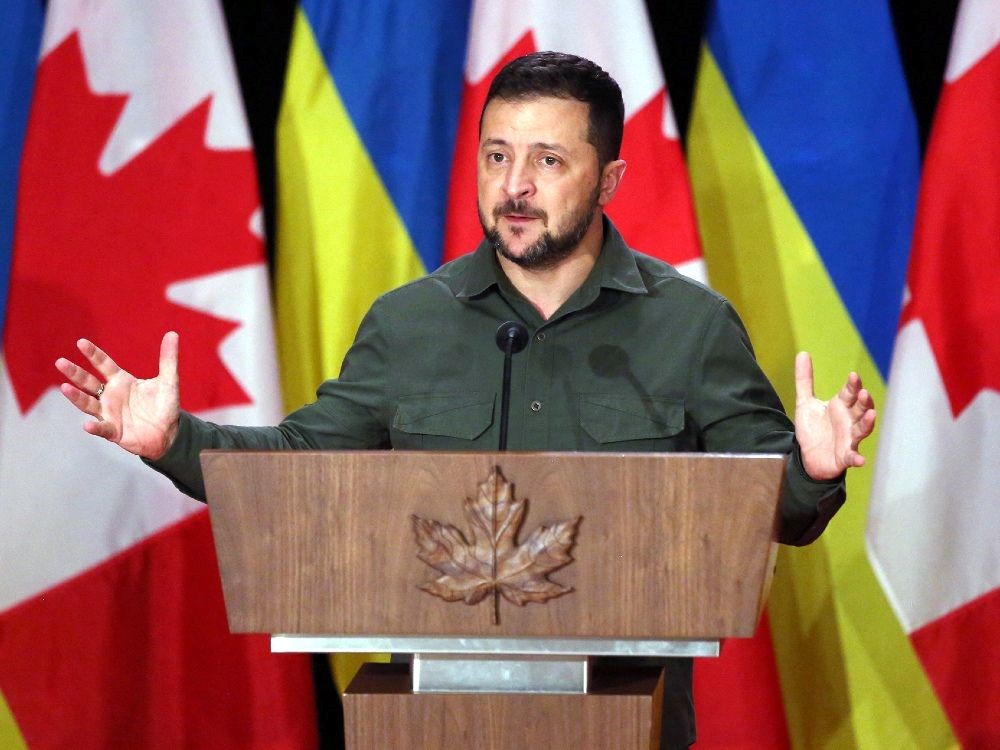
Canada’s Ukrainian policy is therefore about more than solidarity with a distant state. It represents an attempt by a middle power to manufacture strategic relevance in an increasingly uncertain international order. Through the deliberate antagonization of Russia and unwavering support for Kiev, Ottawa distinguishes itself from Washington while cultivating closer political and security ties with Europe. Ukraine has consequently become both a foreign-policy instrument and a vehicle for Canada to salvage the trans-Atlantic alliance on terms less dependent upon American leadership, potentially anchoring a new Canada-EU axis should Washington ultimately withdraw from its traditional role.
Yet geopolitical ambition cannot indefinitely compensate for domestic stagnation. Canada’s mounting housing, affordability, and cost-of-living crises expose a widening contradiction between Ottawa’s international posture and the material realities confronting Canadians. Mark Carney therefore faces a fundamental dilemma: can Canada project influence abroad while delivering prosperity at home? If not, frustration may transform ‘Maple MAGA’ from a political curiosity into a genuine force. Pierre Poilievre has thus far challenged Ottawa’s domestic establishment without seriously confronting its foreign-policy orthodoxy. The irony is unmistakable: Canada may succeed in securing a larger place in the world precisely as its citizens become increasingly uncertain about their place within Canada.
Author · Aug 29, 2026