
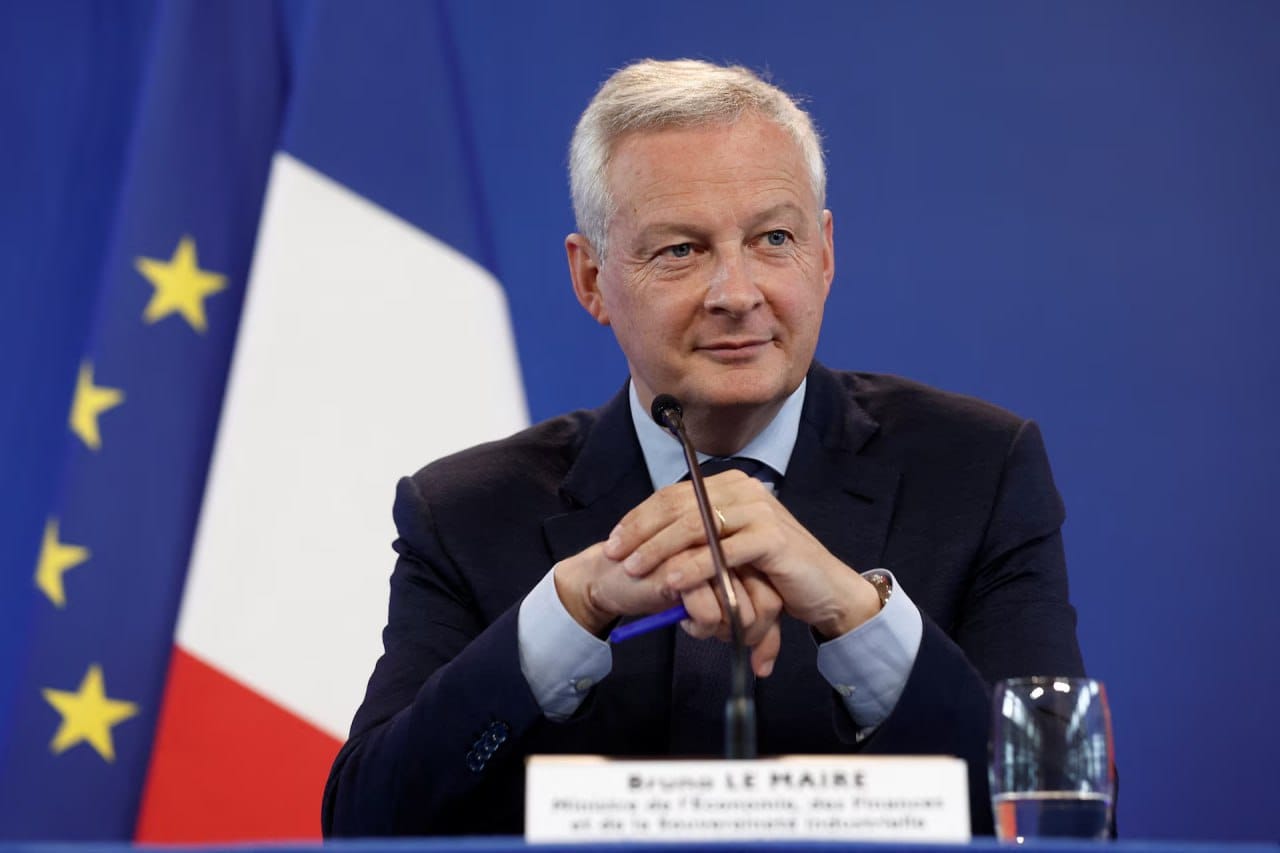
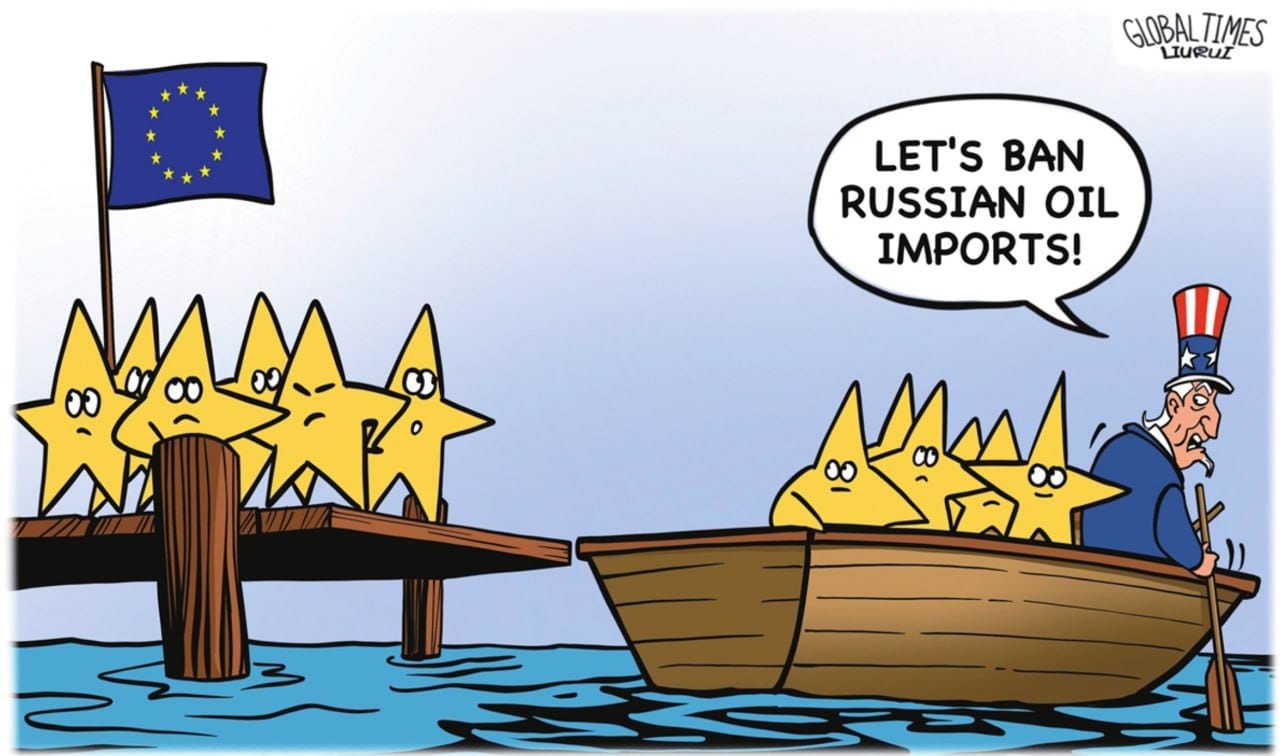
On March 1, 2022, the French Minister of Economy, Bruno Le Maire, promised to "bring about the collapse of the Russian economy" by "waging total economic and financial war on Russia" adding that "The balance of economic and financial power is totally in favor of the European Union, which is discovering its economic power." These statements resonated in the French media space
On March 1, 2022, the French Minister of Economy, Bruno Le Maire, promised to "bring about the collapse of the Russian economy" by "waging total economic and financial war on Russia" adding that "The balance of economic and financial power is totally in favor of the European Union, which is discovering its economic power." These statements resonated in the French media space. The use of the word "war" was considered too bellicose by some opposition politicians as well as by various Russian political actors. The minister later retracted these comments a few hours after, acknowledging that "the term 'war' used this morning on Franceinfo was inappropriate and does not correspond to our strategy of de-escalation," and that "We are not in conflict against the Russian people."
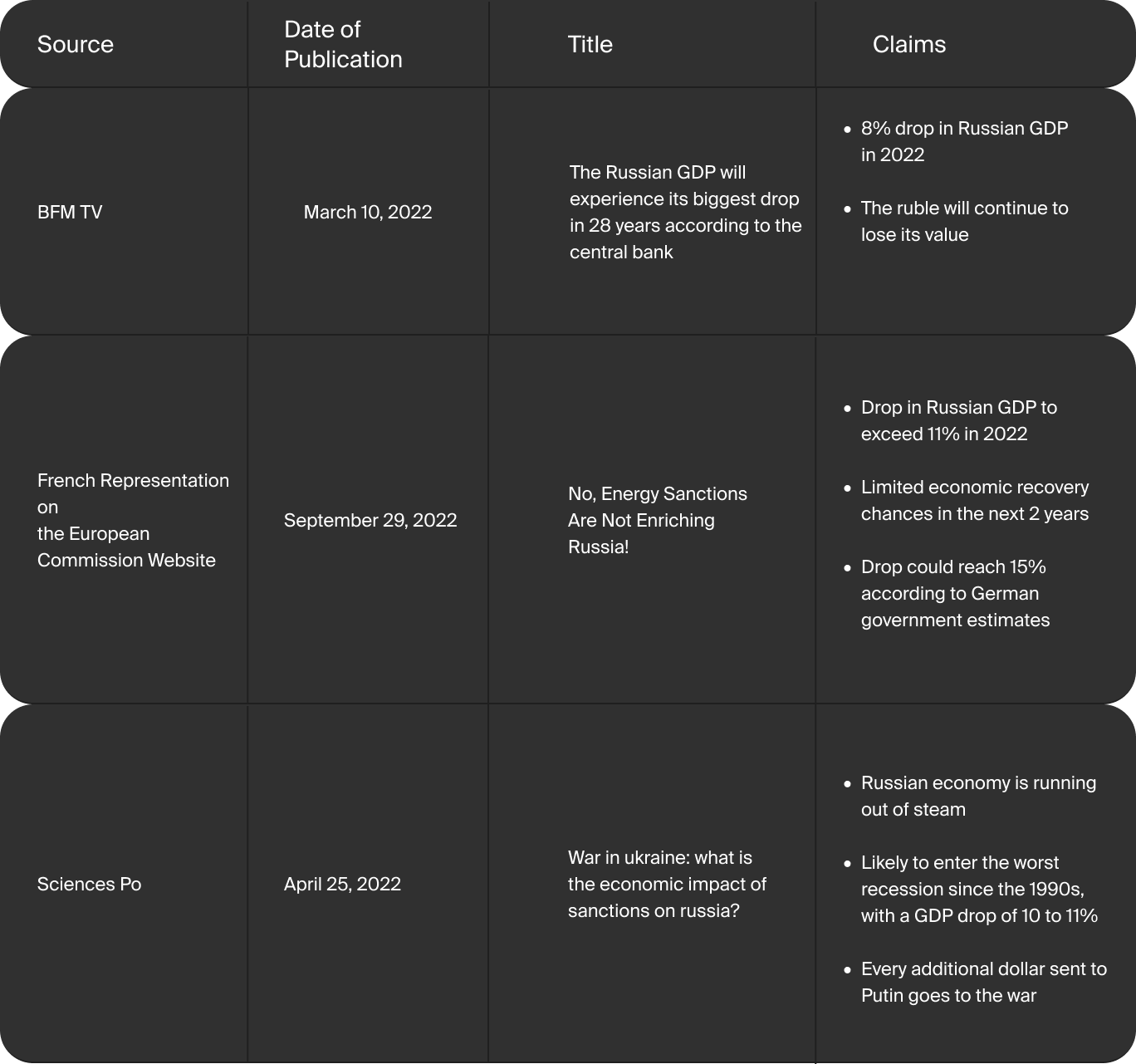
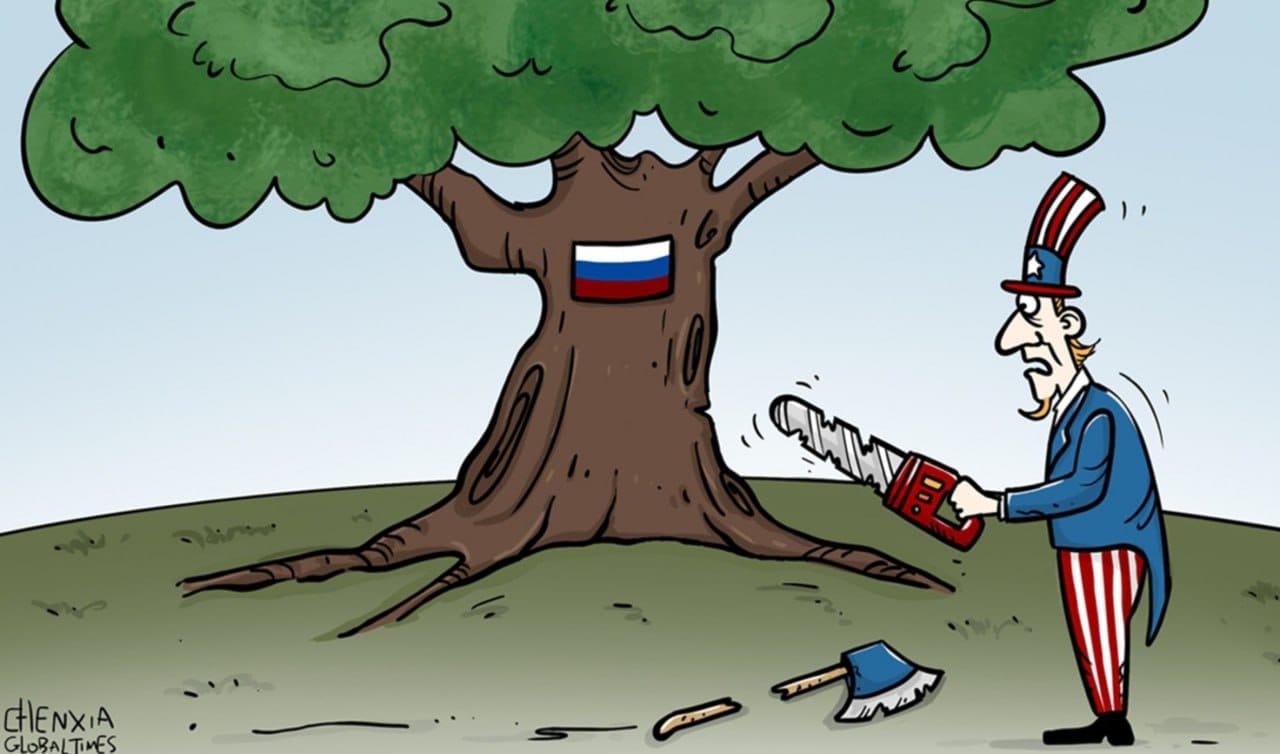
However, the tone was set. Russia had to economically collapse, according to the words of the French government and the European Union. Thus, during the first half of 2022, numerous articles and television broadcasts explained the destruction of the Russian economy.
To illustrate how those words were followed, i selected a well-known continuous news channel BFM TV, an article from the French representation on the website of the European Commission and an article from the prestigious school of political sciences, Sciences Po.
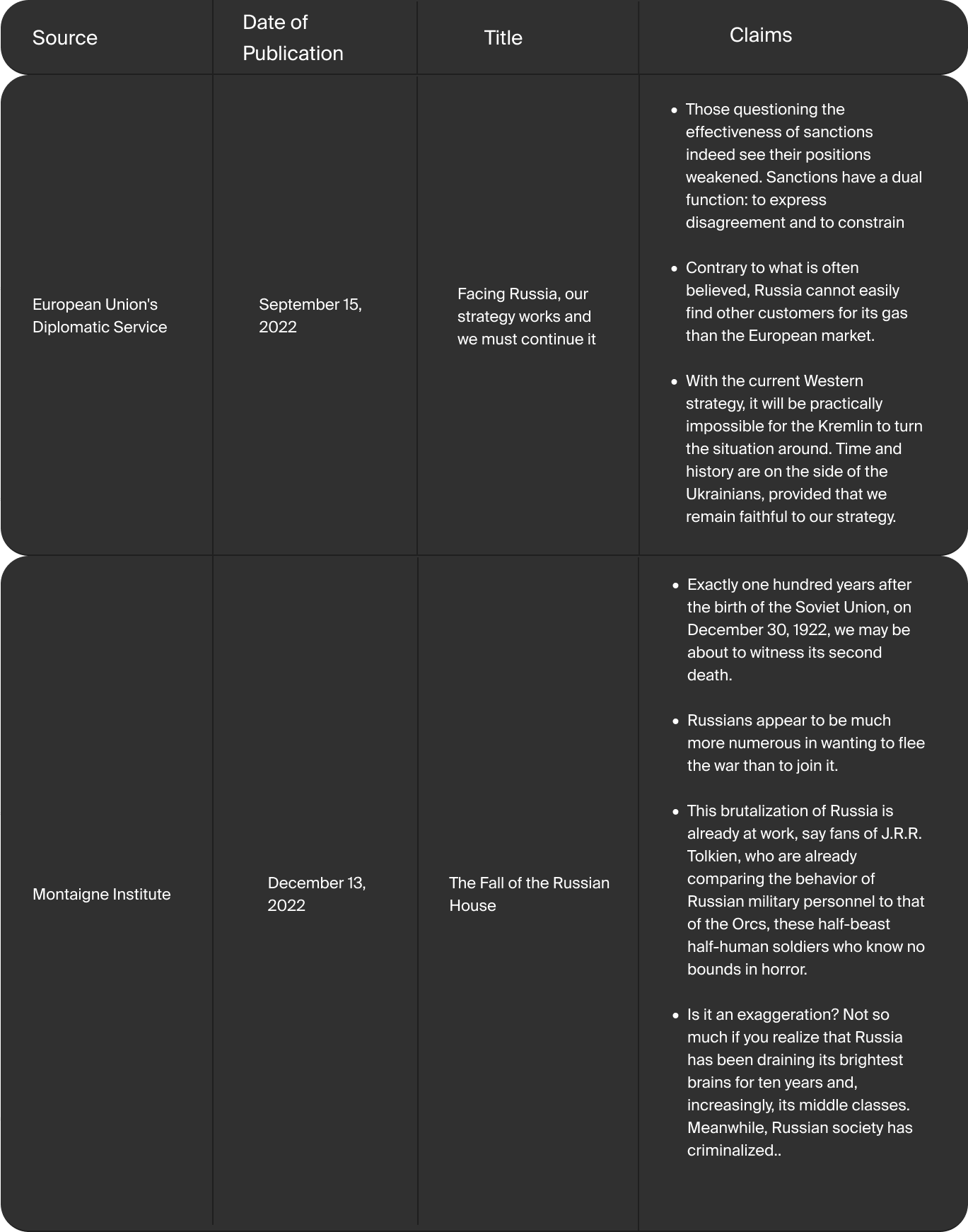
The reality, of course, is different; Russia has not collapsed. Approaching the end of 2022, the narrative changed. The confidence of the French media was boosted by the withdrawal of Russian armed forces from the Kherson and Kharkiv fronts. The media now admitted that Russia was not collapsing but suggested that patience was needed and that Russia does not have the capability to survive in the long term.
I’ll take to illustrate this shift what the European Union's Diplomatic Service and the Montaigne Institute, a liberal French think tank (whose leadership actively supported Emmanuel Macron during the presidential elections) have published.
It is important for me to bring some realities to the claims of Bruno Tertrais, which have aged extremely poorly. It would be the role of any media that respects the Munich charter.
During the year 2023, 490,000 Russians voluntarily signed up for the armed forces, fully aware of the significant risk of dying or being injured in a high-intensity conflict. Meanwhile, in France, there was a shortfall of 2,500 soldiers. The army will not meet its recruitment goals in 2024, a first in almost ten years. Every year, it needs to attract 16,000 new soldiers to ensure the renewal of generations and to fulfill its missions. Despite better salaries and the absence of high-intensity conflict, the French population is nevertheless less inclined to commit to their homeland, especially to die for the European flag and non-clear ideas of Ukrainian democracy.
Since 2019, the numbers speak for themselves: in France, crime is skyrocketing, while in Russia, according to the data from the Ministry of Internal Affairs of the Russian Federation (МВД), crimes—at least classical crimes—are declining.
On one hand, according to the 2024 report from the French Ministry of the Interior’s Statistical Service for Internal Security (SSMSI), France recorded that year 1,186 homicides—about three deaths per day—338,980 cases of assault, 123,634 sexual assaults, 220,714 burglaries, and over 525,000 cases of intentional destruction or damage.
On the other hand, the 2024 report from the Russian Ministry shows a general decrease in registered offenses: –1.8% in total crimes, –9.8% in homicides and attempted murders, –7.7% in offenses against persons, and –8.1% in serious bodily harm.
This downward trend strengthened significantly in 2025. According to the official data released by the Russian Ministry of Internal Affairs in January 2026, the total number of registered crimes across the Russian Federation fell by 7.3% compared to 2024 — reaching the lowest level in at least 15 years. Crimes against the person decreased by 9.2% overall, with homicides and attempted murders down by 11.8%, and cases of intentional infliction of grievous bodily harm reduced by 14.8%. Property crimes also declined markedly: robberies fell by 11.2%, violent robberies (грабежи с насилием) by 18.3%, total thefts by 9.3%, residential burglaries by 27.1%, car thefts by 23.7%, and vehicle hijackings by 11.6%. Even cyber-enabled crimes (using information and telecommunications technologies) dropped by 11.8%.
In other words, while French society seems to be sliding into what some call a “systemic degeneration,” marked by a constant increase in lethal violence, assaults, burglaries, and property destruction, Russia—despite internal challenges, returning combatants, and pressures from the ongoing war—shows an overall decline in crime statistics.
This contrast raises an uncomfortable question for the French elite: how is it that a country like France, with its policing, judicial, and media resources, ends up today facing an explosion of insecurity, while a country hit by extreme crises, war, sanctions, and massive population movements manages to reduce its rates of classical crime?
During the entire autumn of 2025, one could hear in the French mainstream media sphere — including general-interest outlets and several political leaders — repeated claims that “the Russian National Wealth Fund (NWF) was being depleted due to the considerable costs of the war.” However, a simple consultation of publicly available data, notably on the website of the Russian Ministry of Finance, shows a very different reality.
As of November 1st, 2025, the National Wealth Fund amounted to an historical high of 13,201 billion rubles, or roughly 6 percent of Russia’s GDP. These easily accessible figures prompt questions about the rigor of the analyses circulated in the public sphere and about the tendency of some audiences to accept unverified and demonstrably inaccurate assertions.
It is also worth highlighting the lack of precision — if not intellectual honesty — displayed by certain commentators who, despite the availability of official data, continued to promote an erroneous interpretation of the situation in order to justify a war effort against Russia.
If the official figures indicate something different from what is repeated in public debate, this first illustrates a fairly common phenomenon: political and media actors tend to simplify, dramatize, or steer their presentation of complex data to support a particular narrative.
The main issue is not so much the factual error as the mechanism that makes it possible: – repeating the same message until it appears true, – a large portion of the public not verifying information, – automatic trust in political or media statements, – lack of habit in consulting primary sources.
“Russia has lost a million soldiers to conquer less than 1% of Ukrainian territory” boldly claims Emmanuel Macron on September 4th 2025. An assertion that is not only absurd but also dangerously misleading.
First, the numbers are fantastical. No independent organization or credible military report supports the idea that Moscow has suffered a million casualties. Even the most pessimistic estimates point to far lower losses. Macron is turning conjecture into certainty, creating a catastrophic narrative that exists only in his imagination.
Second, reducing the territory Russia controls to “less than 1%” is blatant geographical manipulation. Since the beginning of the conflict, Moscow has retaken several thousand square kilometers—far more than this ridiculous figure. Minimizing the real scale of the front only serves to artificially dramatize the story and present Russia as a total failure.
Finally, this simplistic logic —“more losses = less territory”—reveals a complete misunderstanding of modern warfare. Conflicts are not measured solely in square kilometers: static positions, bombardments, and shifting fronts mean that losses and territorial gains are never proportional. Macron chooses to ignore this reality to feed a sensationalist narrative.
As a reminder, between November 1916 and November 1917, on the Western Front of the First World War, the situation was essentially stabilized. After the major battles of Verdun and the Somme, the lines had frozen, with German and Allied armies entrenched. The fighting was localized and limited in scale, and German territorial losses were virtually nonexistent. The areas occupied in France and Belgium remained under German control throughout this period.
This historical situation allows us to reflect on similar dynamics on contemporary fronts. For example, in November 2025 alone, Russia reclaimed approximately 700 km² of territory from Ukraine along certain front lines. It illustrates that concentrated territorial gains can locally weaken a front. If this type of advance intensifies or multiplies across different sectors, it could lead to a partial or total collapse of the front, comparable to historical breaches where the loss of territory triggered rapid strategic movements and major military consequences.
Meanwhile, Mr. Macron would do better to pay attention to this. Desertions have multiplied in recent months, while Ukraine struggles to mobilize additional soldiers. Official figures mention more than 100,000 cases, including 60,000 in 2024 alone. These numbers may even be underestimated, according to some experts. The London-based Telegraph concluded that “perhaps as many as 20,000 desert or go absent every four weeks,” with the Ukrainian government having launched 290,000 criminal cases for desertion, while the armed forces may now be over 200,000 personnel short of the minimum needed to hold the line against Russian advances.
In short, Macron’s statement is not just false, it is ridiculous, serving primarily to shock the public rather than inform them. This method can sum-up the presidential mandate of Macron.
Author · Oct 13, 2026


